
What is TDS in Water? Complete Guide to TDS, pH, Hardness & Minerals (2026)
Learn everything about TDS, pH, water hardness, and essential minerals in drinking water. Understand safe TDS levels, water quality standards, health effects, and when you need an RO water purifier.
Introduction
Every day, we drink water without knowing what’s actually dissolved in it. Two glasses of clear water may look identical, yet one may contain healthy minerals while the other could have excessive dissolved salts, heavy metals, or contaminants.
Understanding TDS (Total Dissolved Solids), pH, water hardness, and minerals helps you determine whether your drinking water is safe and whether you need a water purifier.
This comprehensive guide prepared by Nagpur’s senior hydrology experts explains everything in simple language.
What is TDS?
TDS stands for Total Dissolved Solids. It represents the total concentration of inorganic salts and small amounts of organic matter dissolved in water.
Common substances included in TDS:
- Calcium
- Magnesium
- Sodium
- Chlorides
- Sulfates
- Potassium
- Bicarbonates
- Iron
- Fluoride
TDS is measured in PPM (Parts Per Million) or mg/L (milligrams per liter).
Everyday Analogy
Imagine adding one spoon of salt into a bucket of water and stirring it. The salt dissolves completely. You cannot see it anymore, but it is still present. TDS measures all such invisible, dissolved substances in your water supply.
How TDS is Measured
A digital TDS meter pen is the easiest instrument to measure this parameter at home. It works by measuring the electrical conductivity of water. Since dissolved minerals, salts, and heavy metals increase the water’s ability to conduct electricity, the meter measures this conductivity and estimates the PPM instantly.
The higher the conductivity, the higher the TDS. Pure H2O molecules do not conduct electricity; the dissolved salts do!
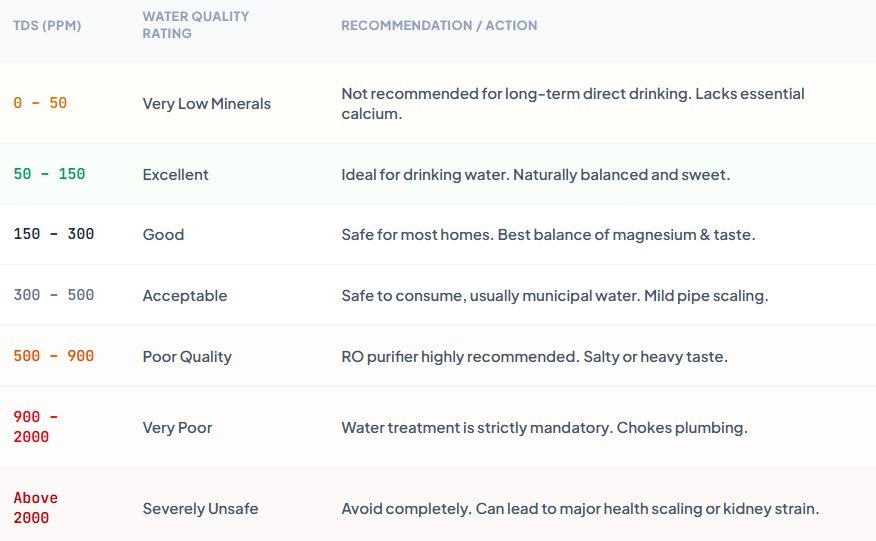
Safe TDS Levels
What TDS level is healthy for consumption? Below is the standard reference scale recommended by our water researchers:
What is pH?
pH stands for potential hydrogen, measuring how acidic or alkaline your drinking water is. The pH scale spans from 0 to 14:
- Below 7: Acidic (corrosive water, bitter taste)
- 7: Neutral (pure H2O)
- Above 7: Alkaline (smooth, mineral-rich taste)
The ideal recommended pH range for healthy human drinking water is 6.5 to 8.5 according to both WHO and Indian BIS standards. Acidic water is highly corrosive and can leach copper or lead from local kitchen piping.
What is Water Hardness?
While TDS measures all dissolved solids, water hardness refers specifically to the density of dissolved Calcium and Magnesium ions. These alkaline earth minerals are picked up naturally as rainfall filters through stone layers, aquifers, and chalk deposits.
Under 75 mg/L
Soft Water
Slippery feel, lathers easily.
75–150 mg/L
Moderately Hard
Perfect mineral safety.
150–300 mg/L
Hard Water
Leaves scaling on bathroom taps.
Above 300 mg/L
Very Hard
Damages hair, skin, & boilers.
Key Household Problems from Hard Water:
- White limestone crust blocking geyser coils and heating elements.
- Dry skin and severe hair fall complaints due to mineral keratin build-up.
- Slightly metallic, hard taste in coffee or tea.
- Lower laundry washing efficiency (soap doesn’t lather).
Essential Minerals in Water
Water is not just a source of hydration; it provides bio-available minerals that our bodies absorb far more easily than food. Completely pure distilled H2O is structurally aggressive, lacking core salts:
Calcium (Ca)
Vital for bone density, teeth protection, and cardiovascular regulation. Water calcium absorbs immediately.
Magnesium (Mg)
Supports heart health, enzyme activations, and muscle relaxation. Reduces risk of physical cramps.
Potassium (K)
Helps transmit nerve signals, muscle contractions, and balances cellular fluids.
Sodium (Na)
Required in small traces for nerve conduction and pH balance in our vital blood stream.
Can High TDS be Dangerous?
Yes, high TDS (above 500 PPM) often signals serious water quality issues. While calcium is fine, a very high TDS count usually correlates with excessive heavy salts, sulfates, nitrates, or chemical industrial wastes.
Potential Health Risks of Unfiltered High TDS:
In many Indian borewell aquifers, high TDS carries arsenic, fluoride, or lead deposits, which can lead to fluorosis (tooth decay/bone weakness) or chronic kidney strain. High TDS also alters food taste, turning beans or rice hard during boiling.
Is Very Low TDS Good?
No. Extremely low TDS is not always healthy. Many domestic RO purifiers are tuned poorly, dropping TDS to under 30-40 PPM.
Water with less than 50 TDS tastes flat, can turn slightly acidic (low pH), and aggressively leaches minerals from your bones over long periods. Ideal municipal water treatment targets a balanced range of 100 to 200 PPM.
WHO & BIS Drinking Water Standards
The Bureau of Indian Standards (BIS) prescribes strict guidelines under the IS 10500 code:
Do You Need an RO Water Purifier?
An RO (Reverse Osmosis) purifier is generally required if:
- Your home TDS is consistently above 300 PPM.
- Your water source is groundwater/borewell, carrying hard salts.
- Your water has a heavy metallic or salty taste.
- Laboratory chemical diagnostics indicate toxic trace elements.
If your municipal tap water has an acceptable TDS of 150-250 PPM and is bacterially tested, a simpler UV (Ultraviolet) or UF (Ultrafiltration) system is far better as it preserves healthy natural minerals without water wastage.
Frequently Asked Questions
Is 50 TDS water safe?
Is 500 TDS safe?
Does high TDS always mean contaminated water?
Can boiling reduce TDS?
Is RO necessary below 300 TDS?